Ads

Showing posts with label Live coverage. Show all posts

Thursday, June 6, 2024

SpaceX to launch its Starship rocket on its fourth test flight

 Greetings space enthusiasts from around the globe! We're moments away from witnessing the awe-inspiring launch of SpaceX's Starship on its fourth test flight, and the energy at Starbase, Texas is electric! This colossal rocket, a behemoth standing at 398 feet (121.3 meters),

is poised to rewrite the future of space travel.

  • Starship (Ship 29): This stainless-steel marvel is the upper stage spacecraft, designed to carry crew and cargo into deep space. Keep an eye out for the three Raptor engines at its base, responsible for the fiery ascent and delicate maneuvers during re-entry.
  • Super Heavy Booster (Booster 11): The workhorse of the operation, this powerful first stage houses a whopping 33 Raptor engines, generating an unbelievable thrust of over 7 million pounds of force!

The Players:
The Mission:
This test flight aims to replicate and refine the maneuvers performed in the previous mission. Here's a closer look at the key stages:
  • Liftoff (T-0): Hold your breath as all 33 Raptor engines on the Super Heavy ignite in a synchronized roar. The ground will tremble with the immense power as the Starship rockets skyward in a pillar of fire.
  • First Stage Ascent (T+0 to ~2.5 minutes): The Super Heavy will propel Starship through the thick atmosphere at an incredible pace, exceeding the speed of sound within seconds. Watch closely for the booster separation – a critical moment where the Super Heavy gracefully detaches and executes a pre-programmed descent for a soft ocean splashdown in the Gulf of Mexico.
  • Second Stage Ascent (T+~2.5 minutes to ~6 minutes): Starship, now on its own, will continue its ascent using its three Raptor engines. This test flight is expected to reach a similar altitude to the previous one, potentially skimming the edge of space before initiating the descent.
  • Belly Flop Maneuver (T+~6 minutes): As Starship re-enters the atmosphere, it will perform its signature belly flop maneuver. With its aerodynamic wing flaps extended, it will reorient itself from a vertical to a horizontal position, using the atmosphere like a giant wing to slow down from hypersonic speeds.
  • Powered Descent and Re-entry Burn (T+~6 minutes to ~8 minutes): Starship will then reignite its three Raptor engines for a controlled descent, performing various maneuvers to test its handling capabilities. Expect fiery plumes as the engines bite into the atmosphere.
  • Landing Attempt (T+~8 minutes): The final, heart-stopping moment will be the landing attempt. Unlike previous flights targeting the landing pad, Ship 29 will aim for a soft ocean splashdown in the Indian Ocean. This will provide valuable data on controlled re-entry and water recovery techniques.
Expert Commentary:


Throughout the broadcast, we'll be joined by leading spaceflight experts who will dissect the technical complexities of each stage. They'll explain the challenges of operating a super heavy-lift launch vehicle and the significance of this test flight for achieving full reusability – a revolutionary step towards cost-effective space travel.

Beyond the Launch:

This Starship test flight is a crucial stepping stone towards a future with Starship shuttling humans and cargo to the Moon, Mars, and beyond. Stay tuned for post-launch analysis and insights from SpaceX on the success of the mission's objectives.

Join the Conversation!

Share your excitement and ask questions in the comments below! Let's celebrate this historic moment together as we witness the power and potential of Starship!


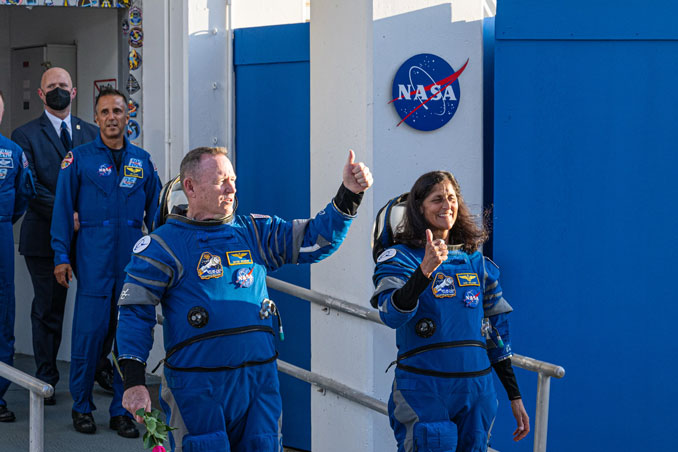
Live coverage: Third time’s the charm for the Boeing Starliner Crew Flight Test


T-minus 2 hours: Anticipation hangs thick in the air at Cape Canaveral Space Force Station. Technicians meticulously run final checks on the Atlas V rocket and the Boeing Starliner spacecraft. Astronauts Butch Wilmore and Suni Williams are strapped into their seats, their calm professionalism belying the excitement surely coursing through them. This is it – the culmination of years of training and preparation, the third attempt at this historic flight.


T-minus 1 hour: Launch commentators provide updates on the countdown sequence, their voices a steady hum against the backdrop of crackling communication between mission control and the spacecraft. News channels around the world buzz with activity, reporters offering commentary and interviews with space experts. Social media explodes with excitement, a sea of hashtags and well wishes flooding platforms.


T-minus 30 minutes: The launchpad is bathed in the golden light of the morning sun. Engineers double-check every system, a final confirmation before unleashing the immense power of the Atlas V. Wilmore and Williams perform final system checks, ensuring their instruments and suits are functioning perfectly.


T-minus 10 minutes: The tension escalates. Launch commentators switch to a rapid-fire cadence, detailing the final steps of the countdown. The ground trembles with a low rumble as the rocket ignites its engines. A plume of fire erupts, engulfing the launchpad in a fiery embrace. The Starliner, a beacon of white against the orange inferno, begins its ascent.


Liftoff! Cheers erupt in mission control, a cacophony of joy and relief. The massive Atlas V effortlessly lifts off, carrying the Starliner skyward with a vengeance. Cameras capture the awe-inspiring spectacle – the fiery trail blazing a path through the clear blue sky, the Starliner rapidly shrinking into a tiny white speck against the vastness of space.


Stage Separation: After a few heart-stopping minutes, the first stage of the Atlas V falls away, leaving behind a trail of smoke as it plummets back towards Earth. The second stage ignites, propelling Starliner further into its intended orbit. Mission control confirms successful engine burns, a collective sigh of relief echoing through the room.


Orbital Insertion: Approximately 30 minutes into the flight, the Starliner successfully reaches its target orbit. Cheers erupt anew as Wilmore and Williams report feeling weightlessness, a confirmation that they are officially in space. Relief gives way to a sense of wonder as they gaze out the viewport, Earth a breathtaking blue marble suspended against the blackness of space.


Mission Update: Throughout the day, viewers are treated to live updates from inside the Starliner. Wilmore and Williams conduct routine checks on the spacecraft's systems, providing commentary on their experience and the incredible views they are witnessing. Mission control relays updates on the trajectory and upcoming milestones, keeping the audience informed and engaged.


Docking Preparations: As the hours tick by, excitement builds towards the next major milestone: docking with the International Space Station (ISS). Wilmore and Williams review procedures and prepare the Starliner’s docking systems. Mission control coordinates with the ISS crew, ensuring a smooth and successful connection.


Docking with the ISS (Estimated – June 6th, 12:15 PM EDT): (This section will need to be updated on June 6th to reflect the actual docking time). Anticipation reaches a fever pitch as Starliner approaches the ISS. Live feeds showcase the awe-inspiring sight of the two colossal structures slowly merging in space. After a series of automated maneuvers and final checks from both crews, Starliner successfully docks with the ISS. Cheers erupt once again as the hatches open, signifying a new chapter in human space exploration.


This is just the beginning: While the successful launch is a major milestone, the crew still has a busy schedule ahead. Over the next week, Wilmore and Williams will conduct joint research with the ISS crew, test Starliner's systems, and participate in educational outreach programs. Their successful return to Earth will mark the final test for the spacecraft, paving the way for regular crew rotations and solidifying Boeing's presence in the commercial spaceflight industry.


Stay tuned: This live coverage will continue throughout the mission, providing updates on docking, crew activities, and the eventual return to Earth. Stay connected for more exciting developments from space!